Sunday, September 21, 2014

DG Khan Board

                                                          OLD PAPERS                                                         

Old Papers of Matric (Part-II) 10th class (Annual) Examination, 2014

Old Papers of Matric (Part-I) 9th class (Annual) Examination, 2014

Old Papers of Intermediate (Part-II) 12th class (Annual) Examination, 2014

Old Papers of Intermediate (Part-I) 11th class (Annual) Examination, 2014 


government funding for education, free educational resources, web design education, education sites for students, educational posters for classrooms, paraprofessional education, education employment, educational resources for teachers, drivers education classes, educational leadership articles, education grants for teachers, character education curriculum, educational videos for teachers, education sponsors, ascd educational leadership, online drivers education, music education supplies, education agencies, adult education grants, ukraine education, educational field trips, educational scholarships, educational visits, education cuts

Bahawalpur Board

                                                          OLD PAPERS                                                         

Old Papers of Matric (Part-II) 10th class (Annual) Examination, 2014

Old Papers of Matric (Part-I) 9th class (Annual) Examination, 2014

Old Papers of Intermediate (Part-II) 12th class (Annual) Examination, 2014

Old Papers of Intermediate (Part-I) 11th class (Annual) Examination, 2014 


Bahawalpur Board | D.G. Khan Board | Faisalabad Board | Gujranwala Board 
Lahore Board | Multan Board | Rawalpindi Board | Sahiwal Board | Sargodha Board
government grants for education, educational leadership magazine, federal education grants, education grant, educational sites for students, drivers education courses, the times education, education english, educational equipment, marketing education, education of india, educational policies, current events in education, department of education and science, adult education online, mexican education, educational foundations, higher education grants, driving education, education background check, kids educational sites, educational software companies, early childhood education curriculum

Saturday, September 20, 2014

Windows shortcut keys, Natural shortcuts

We can open tasks very speedy by the using of shortcut keys. Windows has provide us a better and fast way to open tasks through shortcut keys, the following keys are used generally in every software some of the following are used in routine:

Shortcut Keys

Press
To
CTRL+C
Copy.
CTRL+X
Cut.
CTRL+V
Paste.
CTRL+Z
Undo.
DELETE
Delete.
SHIFT+DELETE
Delete selected item permanently without placing the item in the Recycle Bin.
CTRL while dragging an item
Copy selected item.
CTRL+SHIFT while dragging an item
Create shortcut to selected item.
F2
Rename selected item.
CTRL+RIGHT ARROW
Move the insertion point to the beginning of the next word.
CTRL+LEFT ARROW
Move the insertion point to the beginning of the previous word.
CTRL+DOWN ARROW
Move the insertion point to the beginning of the next paragraph.
CTRL+UP ARROW
Move the insertion point to the beginning of the previous paragraph.
CTRL+SHIFT with any of the arrow keys
Highlight a block of text.
SHIFT with any of the arrow keys
Select more than one item in a window or on the desktop, or select text within a document.
CTRL+A
Select all.
F3
Search for a file or folder.
CTRL+O
Open an item.
ALT+ENTER
View properties for the selected item.
ALT+F4
Close the active item, or quit the active program.
CTRL+F4
Close the active document in programs that allow you to have multiple documents open simultaneously.
ALT+TAB
Switch between open items.
ALT+ESC
Cycle through items in the order they were opened.
F6
Cycle through screen elements in a window or on the desktop.
F4
Display the Address bar list in My Computer or Windows Explorer.
SHIFT+F10
Display the shortcut menu for the selected item.
ALT+SPACEBAR
Display the System menu for the active window.
CTRL+ESC
Display the Start menu.
ALT+Underlined letter in a menu name
Display the corresponding menu.
Underlined letter in a command name on an open menu
Carry out the corresponding command.
F10
Activate the menu bar in the active program.
RIGHT ARROW
Open the next menu to the right, or open a submenu.
LEFT ARROW
Open the next menu to the left, or close a submenu.
F5
Refresh the active window.
BACKSPACE
View the folder one level up in My Computer or Windows Explorer.
ESC
Cancel the current task.
SHIFT when you insert a CD into the CD-ROM drive
Prevent the CD from automatically playing.

Natural shortcut keys

You can use the following keyboard shortcuts with a Microsoft Natural Keyboard or any other compatible keyboard that includes the Windows logo key (Windows logo key) and the Application key (WINDOWS).
Press
To
WINDOWS
Display or hide the Start menu.
WINDOWS +BREAK
Display the System Properties dialog box.
WINDOWS +M
Minimize or restore all windows.
WINDOWS +E
Open My Computer.
WINDOWS +F
Search for a file or folder.
CTRL+ WINDOWS +F
Search for computers.
WINDOWS +F1
Display Windows 2000 Help.
WINDOWS +R
Open the Run dialog box.
WINDOWS +TAB
Switch between open items.
WINDOWS
Display the shortcut menu for the selected item.
WINDOWS +U
Open Utility Manager

 >>> Click here for More articles relating to computer  <<<
pre school education, counselor education, early childhood education colleges, online educational games for kids, african education, information about education, government education grants, educational conferences, sustainability education, character education programs, switzerland education, education current events, special education lesson plans, music education jobs, education internships, kenya education, history education, list of educational websites, educational stores, special education schools, education rights, continuing education courses, information technology in education, it in education, home education resources, drivers education online, education furniture, early childhood education programs, software education, distant education, education charity, educational films, masters in education programs, online masters degree in education, online education degree

describe keyboard and also tell about QWERTY keyboard.

What is Keyboard?
The set of typewriter like keys that enables you to enter data into a computer. Computer keyboards are similar to electric typewriter keyboards but contain additional keys. The keyes on computer keyboards are often classified as follows:

Alphanumeric Keys:
letters and numbers comma, period, semicolon, and so on.

Navigation and Editing keys:
Arrow keys, insert, home, delete keys and so on.

Numeric Kyes:
Num Pad.

Function Keys:
Special Purpose Keys from F1 to F10 or F12.

The standard layout of letters, numbers, and punctuation is known as a QWERTY keyboard because the first six keys on the top row of letters spell QWERTY. The QWERTY keyboard was designed in the 1800s for mechanical typewriters and was actually designed to slow typists down to avoid jamming the keys. Another keyboard design, which has letters positioned for speed typing, is the Dvorak keyboard.

There is no standard computer keyboard, although many manufacturers imitate the keyboards of PCs. There are actually three different PC keyboards: the original PC keyboard, with 84 keys; the AT keyboard, also with 84 keys; and the enhanced keyboard, with 101 keys. The three differ somewhat in the placement of function keys, the Control Key, the Return key, and the Shift keys.

In addition to these keys, IBM keyboards contain the following keys: Page Up, Page Down, Home, End, Insert, Pause, Num Lock, Scroll Lock, Break, Caps Lock, Print Screen.
multimedia keyboard

There are several different types of keyboards for the Apple Macintosh. All of them are called ADB keyboards because they connect to the Apple Desktop bus (ADB). The two main varieties of Macintosh keyboards are the standard keyboard and the extended keyboard, which has 15 additional special function keys.
Standard Keyboard

>>> Click here for More articles relating to computer  <<<
alternative education programs, educational consulting, haiti education, leadership in education, equality in education, times education jobs, management education, character education worksheets, educational psychologists, home education uk, jobs in education sector, internet education, education franchise, educational worksheets, mba education, childrens educational games, nursery education, certificate in education, adult sex education, educational publishers, physical education equipment, early child education, social work education, educational games for children, military education, education degree online, dictionary education, scholarship for higher education, education welfare officer jobs, education evaluation, education expo, general education diploma, education for women, education policies

Computer Concepts / What is computer?

COMPUTER CONCEPTS
Computer is a need of modern World, new age is the age of computer, every person want to learn about computer, computer is solving many problems of mankind, computer is need of each field and business. This tutorial is provide you basics of computer which are as under:

Computer Concepts
Computer Concepts
What is data?
Data is the collection of facts and figures.
What is Information?
Information is the required result after processing of Data.
Data is the collection of facts and figures.
Information is the required result after processing of Data.
What is Data Processing Cycle?
When we input data through input devices into computer then processor process it, after process show information we can store information in computer drives and also see it on display screen.
Data Processing Cycle
 What is computer?
Computer is an electronic device, which receives data, processes it and gives results.
What is Computer?
 What are major parts of computer?
Computer is divided into "Three" major parts:
1. Input Devices.
2. Output devices.
3. CPU (Central Processing Unit)
Major Parts of Computer.
 Which are input devices?
By help of input devices we can send data into computer.
Input Devices
 Which are types of input devices?
* Keyboard
* Mouse
* Scanner
* C-Pen
Type of Input Devices
 What is laptop?
Laptop is a small computer which is flexible we can move it from one place to another place easily. Laptop is latest technology of the modern World, every person has own laptop. Laptop is very helpful for students, businessman's as well as every field of life.
Laptop
 What is output devices?
Output devices are used to display some kind of data from computer.
Output Devices
 Which are types of output devices?
>> Monitor
>> Printer
>> Plotter
Types of output devices
 What is laser printer?
Laser printer is used to print data from printer to get a hard copy.
Laser Printer
 What is plotter?
Plotter is a big printer. Plotter is used to print large size papers from computer.
Plotter Printer
 Printing procedure example from plotter printer.
Printing Procedure in Plotter
 What is usage of input and output devices. the following picture represent the working of input and out put devices. Mouse and keyboard are input devices. We input data through mouse and keyboard, after that processor process it and Monitor show information. Monitor is output device and printer is also output device which is use to print data for making hard copies.
Process of computer devices
 The following picture is represent motherboard and CPU. You can create idea about motherboard, processor.
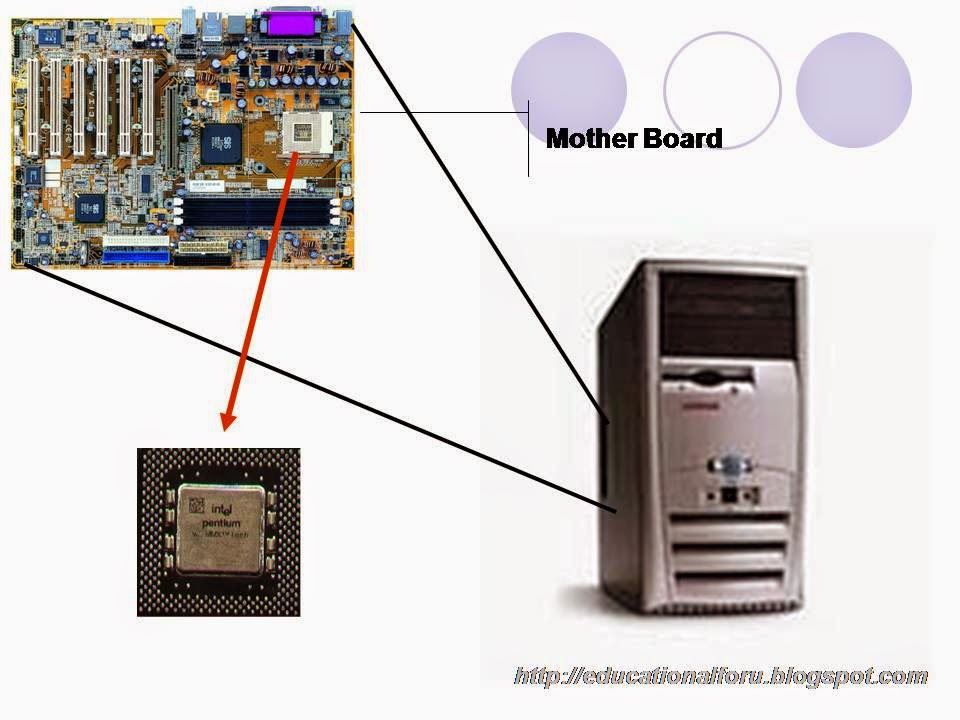
CPU under side parts
 Motherboard highlighted in this picture.
Motherboard
 What is CPU?
CPU is central processing unit.
It is main part of the computer where every process accomplish that we perform.
CPU (Central Processing Unit)
 Which are types of CPU (Central processing unit)?
central processing unit consisting following types:
>> control unit.
>> ALu (Arithmetic/logic Unit).
>> Registers.
CPU Units
 What is memory?
Memory is that place in computer where we can store our programs and data.
Memory
 How many types of Memory?
Memory has two types:
(i) Primary Memory
(ii) Secondary Memory
Types of Memory
What is primary memory?
A temporary storage area of computer.
Primary Memory
 How many types of Memory?
(i) ROM (Read only memory)
(ii) RAM (Random Access Memory)
Primary Memory types
 The following picture is represent to RAM.
RAM
 What is Secondary Memory?
Secondary Memory is a storage are of computer.
Secondary Memory
Which are types of  Secondary Memory?
Secondary Memory have many types some of the types are as under:
(i) Hard Disk
(ii) Floppy Disk
(iii) CD
Secondary Memory Types
 CD image is as under:
CDs
 Floppy Disk is as under:
Floppy Disk
 Hard drive picture.
Hard Disk
 CD ROM working is as under but to check CD ROM working download attached link which open in Microsoft Powerpoint.
CD ROM and its working 1

CD ROM and its working 2
 Unit of Memory Measurement.
Unit of Memory Measurement
 A brief summary can be written as:
8 bits = 1 byte
1024 bytes = 1 kilo byte
1024 kilo bytes = 1 mega byte
1024 mega bytes = 1 giga byte
1024 giga bytes = 1 tara byte
1024 tara bytes = 1 hexa byte
A brief summary about measurement units
 What is elements of computer?
Computer have two elements which are as under:
>> Hardware.
>> Software
Elements of computer
 How many types of Software?
1. System Softwares
2. Application Softwares.
3. Langugae Software.

Types of software
 System Software
System software's are used to operate, control and extend the processing capabilities of computers.
System Software Definition
 System Softwares
Operating Systesm.
System Software
 What is operating system?
An operating system is defined as a program.
It acts like a platform for application.
It actually helps to communicate between software and hardware.
Operating System Definition
 how many operating systems?
Single user operating system (for stand alone PC)
1. DSO (Disk operating system)
2. Windows (3.1, 3.11, 95, 98, me)
Multi user operating system (for networks)
1. Unix/linux
2. Novel
3. Windows NT/2000/XP
Types of Operating System
 What is application software?
Application software is software that is designed for a specific purpose or use.
They can solve only one type of problems.
Definition of Application Software
Applications softwares:
1. Word Processor
2. Spread Sheet
3. Data Bases
4. Graphics
5. Internet

Types of Application Software
 Language software
C++
Visual Basic
Fortran
Java
Language software
To download above said computer concepts in powerpoint format click here


education city game, educational furniture, bachelor of education primary, bachelor of education online, education posters, education slogans, use of computer in education, art education jobs, education queensland jobs, discovery education videos, educational toy, online education websites, educational online games, education consultancy, army education, special education degree, executive education programs, nurse education, education toys, hbs executive education, educational products, adventure education, higher education marketing, pci education, education nation, educational software for kids, statement of special educational needs, best educational toys, radiology education, educational psychologist jobs, south african education, education unlimited, diploma in early childhood education, world education games, education training, education programs, education administration jobs, education books

Index page updated links